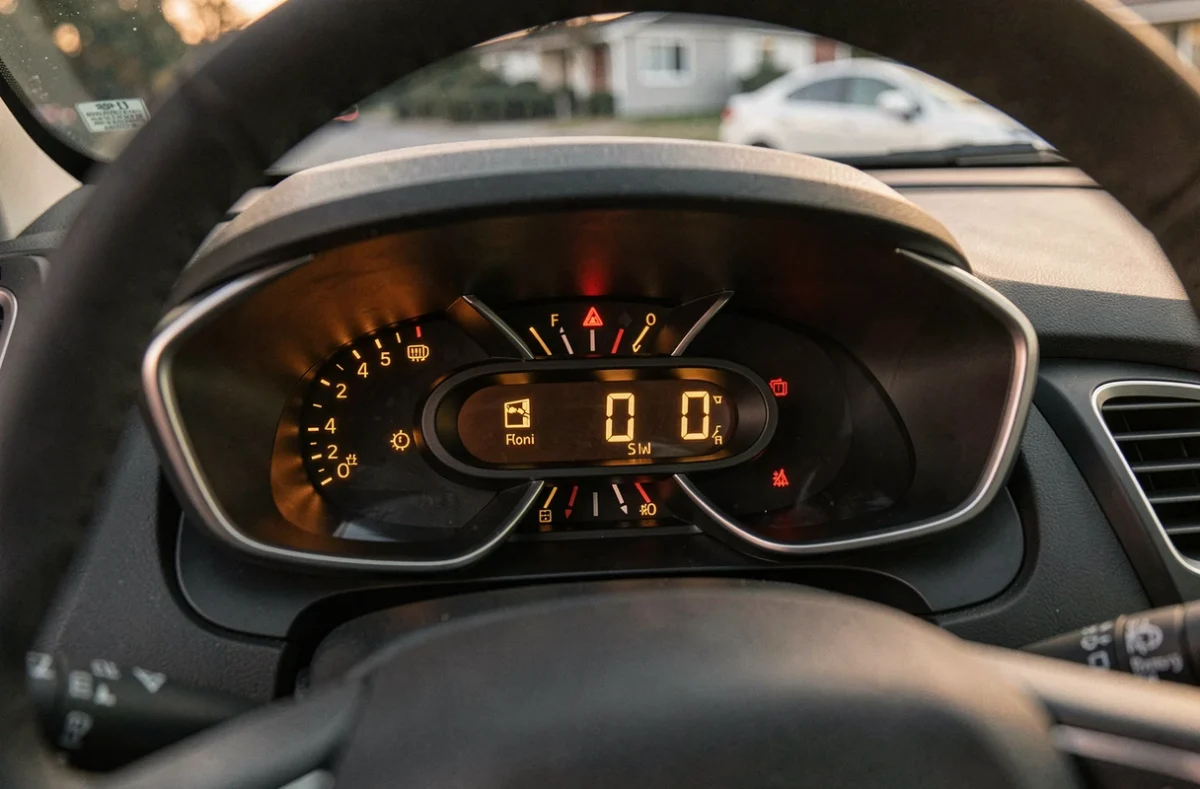
The dashboard of the Clio 3 displays about ten different warning lights, organized according to a standardized color code. Each light corresponds to a specific circuit or component of the vehicle. The challenge with this Renault model, produced between 2005 and 2012, lies less in the number of lights than in the confusion between visually similar alerts that have very different consequences.
Color code of Clio 3 warning lights: three levels of severity to distinguish
| Light Color | Severity Level | Expected Reaction |
|---|---|---|
| Red | Serious Alert | Immediate vehicle stop, engine shutdown |
| Orange / Amber | Functionality Anomaly | Cautious driving possible, quick appointment at the garage |
| Green / Blue | Information | No action required, simple confirmation of activation (turn signals, high beams, etc.) |
This color classification has been common among most manufacturers since the 1990s. On the Clio 3, it remains the first reliable sorting reflex. A red light always requires a stop, without exception.
Where confusion arises is among the orange lights. Some indicate a gradual degradation (wear of brake pads, low fluid level), while others signal an active electronic failure that can worsen within a few kilometers. The color alone is not enough: it is necessary to cross-reference the pictogram and, on equipped versions, the message displayed by the onboard computer.
To delve deeper into the meaning of Clio 3 dashboard lights, the intersection of color, symbol, and message remains the most reliable method before any intervention.

Clio 3 injection light: two messages that drivers confuse
The Clio 3 phase 2 displays two distinct messages related to injection on the onboard computer. They look similar, but do not require the same reaction at all.
- “Injection Failure”: serious alert classified in red. The driver must immediately turn off the engine, park safely, and call for assistance.
- “Injection to Check”: functionality anomaly. Cautious driving to the garage is still possible, provided a quick appointment is made.
- A third case exists: the temperature light that starts flashing can also indicate an injection failure, adding to the confusion.
Thus, three different lights can indicate an injection problem on this model. This peculiarity explains why so many Clio 3 drivers hesitate between stopping immediately and continuing to the garage. The distinction between “failure” and “to check” is not a mere vocabulary detail: it separates an emergency stop from a simple appointment.
Engine light on and technical inspection: direct consequence on the Clio 3
A point rarely anticipated by Clio 3 owners still on the road concerns the link between the engine light and technical inspection. An active “check engine” light at the time of inspection requires a repair, followed by a re-inspection after the light goes out.
On a vehicle of this generation, the engine light frequently comes on for minor causes: worn lambda sensor, clogged EGR valve, differential pressure sensor of the particulate filter out of tolerance. The cost of repair sometimes exceeds the residual value of the vehicle, which leads some owners to drive with the light on.
This strategy has a hidden cost: refusal at the technical inspection. In practice, any Clio 3 presented with an active engine light will be rejected. The repair then becomes not optional but mandatory to retain the right to drive.
Critical red lights not to confuse on Clio 3
The engine temperature light and the oil pressure light share a close location on the Clio 3 instrument cluster. Both are red, and both require a quick stop.
The temperature light (thermometer-shaped pictogram) signals overheating of the coolant. Continuing to drive risks causing engine seizure. The oil pressure light (burette-shaped pictogram) indicates a drop in pressure in the lubrication circuit. Both situations can lead to engine failure if ignored, but the causes and immediate checks differ.
For the temperature light: check the coolant level when cold, visually inspect the condition of the expansion tank cap and hoses. For the oil light: check the level on the dipstick, with the engine stopped for a few minutes.

Airbag light and service light on Clio 3: two alerts often simultaneous
The simultaneous illumination of the airbag light (orange) and the “Service” message is a case frequently reported by Clio 3 owners. This combination does not mean that the vehicle is immobilized, but it indicates that the restraint system will not deploy in the event of a collision.
The airbag light alone may result from a corroded connector under the driver’s seat, a seatbelt pretensioner issue, or a fault in the airbag control unit. Diagnosis requires an OBD scanner to read the exact fault code. Without reading the code, any intervention remains guesswork.
The accompanying “Service” message often corresponds to a periodic maintenance reminder, triggered by the mileage counter. The two alerts are independent, even if their simultaneous appearance suggests a single failure. Treating each light separately avoids unnecessary repairs.
On an aging Clio 3, the multiplication of warning lights illuminated simultaneously rarely indicates a chain failure. It rather reflects the accumulation of small uncorrected faults over the years, each activating its own light. Reading the fault codes with a diagnostic tool remains the only reliable approach to prioritize repairs according to their actual urgency.